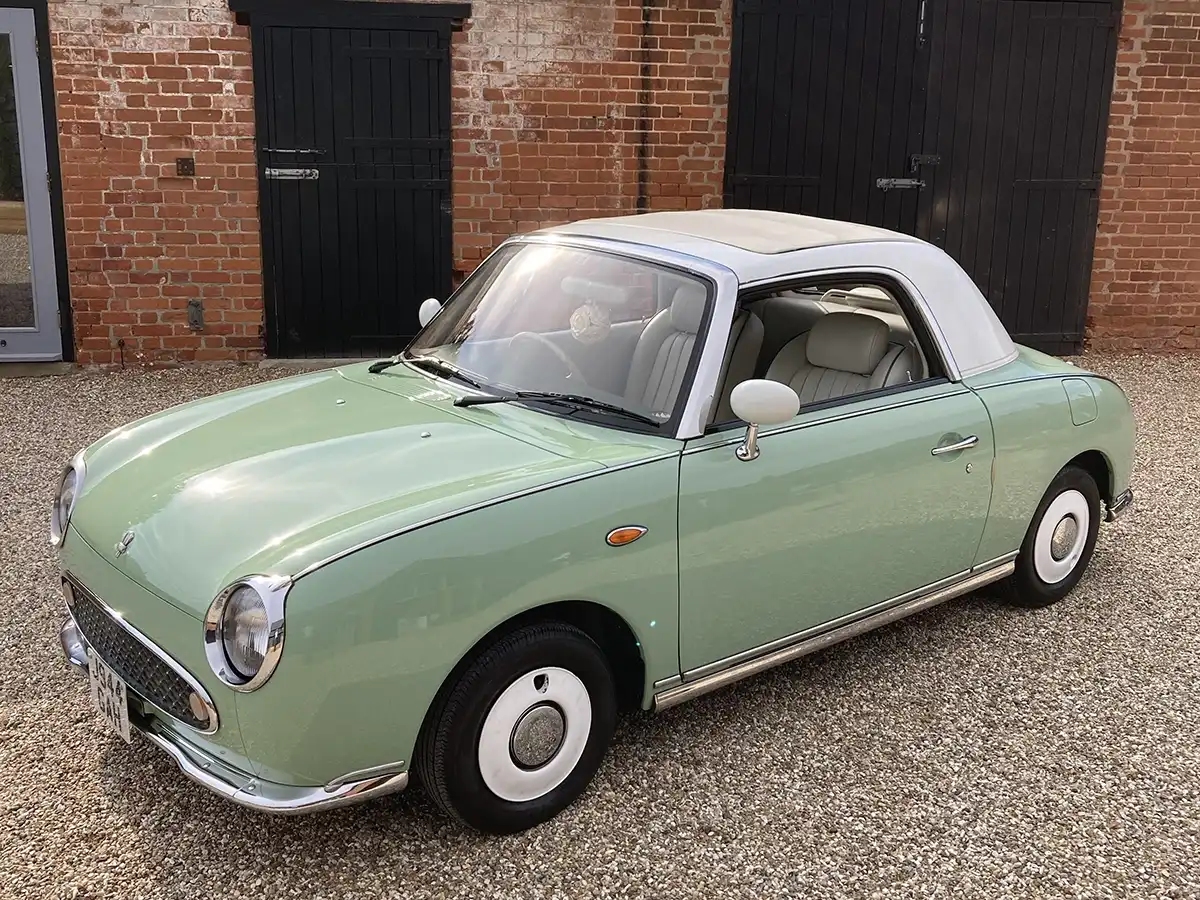
About the Nissan Figaro
Retro, rare and reliable. Only 20,000 Figaros were ever built, all of them in a single year, and you had to win a lottery to buy one.
Here is where the car came from, and what is actually underneath her.
Back to the Future, 1989
The Figaro was unveiled at the 1989 Tokyo Motor Show under the slogan ‘Back to the Future’, and the phrase fits it well: a brand new car designed to look forty years older than it was. It came out of the Japanese ‘boutique’ movement, a short burst of small-run, deliberately characterful cars, and it beat the rest of the motor industry to the retro trend by a good ten years.
It is a 2+2 cabriolet, and it was styled by Shoji Takahashi and Naoki Sakai. The name Figaro is not an acronym or a project code – the chairman of Nissan simply named it after his favourite opera, Mozart’s The Marriage of Figaro. Which is a happy coincidence for a car that now spends most of its weekends at weddings.
Twenty thousand cars, sold by lottery
Nissan planned a run of 8,000. Demand was so far beyond that they built another 12,000, and even then there were nowhere near enough to go round – more than 200,000 people applied, so buyers were picked by ballot. Every car was released between February and December 1991, and all of them were sold in Japan only. The base price when new was 1.87 million yen – roughly £7,300 at exchange rates back then.
The Figaro was surprisingly expensive. Although based on Nissan’s inexpensive 1-litre March, it cost more than twice as much and was priced alongside proper sports cars such as the Mazda MX-5. It was effectively a premium boutique car disguised as a tiny retro Nissan.
Many have since been exported, and because Japan drives on the left like us, Britain took to them more than most. In 2026 there are approximately 2,200 roadworthy Figaros left in the UK.
Four colours, four seasons
There were only ever four factory colours, one for each season: Emerald Green for spring, Pale Aqua for summer, Topaz Mist for autumn and Lapis Grey for winter. That is the whole palette – every Figaro you have ever seen is one of those four, unless it has been resprayed.
 Emerald Green for spring
Pale Aqua for summer
Topaz Mist for autumn
Lapis Grey for winter
Emerald Green for spring
Pale Aqua for summer
Topaz Mist for autumn
Lapis Grey for winter
The details, once you start looking
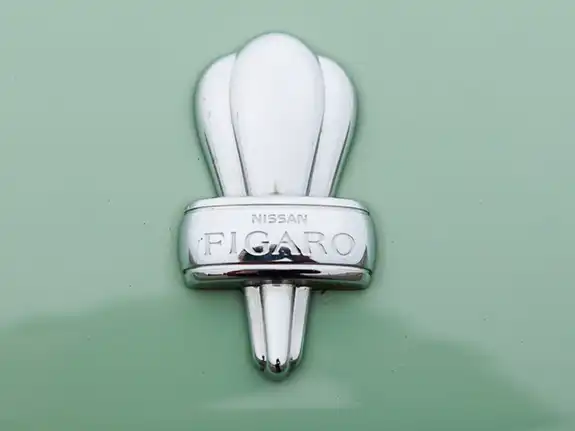
The fleur de lys on the bonnet is the car’s signature, and once you have noticed it you find it everywhere: on the interior switches, the heater control panel, the door sill tread plates, the centre boss of the steering wheel, the CD player knobs, the window winders and around the door handles.


The word ‘Nissan’ is on the car too, in several places including that bonnet badge and the bottom of the rear number plate surround – but nowhere is the lettering taller than half a centimetre. You have to know to look. There are odd little touches inside as well, right down to the breakdown flare Nissan supplied as standard.


Specification and build
The Figaro is a front-engined, front-wheel-drive two-door cabriolet built on the Nissan Micra/March platform, with chrome bumpers and trim. The body is steel, but the nose and front wings are glass fibre with a gel coat, finished in Fluoroplastic paint.

Nissan did not build it themselves. The work was sub-contracted to Takada Kogyo at the Fukushima plant, which also turned out the other boutique oddities of the period – the Be-1, the Pao and the S-Cargo.
The engine is the MA10ET, a turbocharged four-cylinder in-line of 987cc producing 76 PS at 6,000 rpm, through a three-speed automatic gearbox. Maximum speed is 97 mph. Suspension is independent at the front with a trailing beam axle at the rear, steering is power-assisted rack and pinion, and braking is by vented discs at the front and drums at the rear.

Standard equipment was generous for 1991 and included right-hand drive, power steering, leather seats, air conditioning, a CD and cassette player, electric windows and the folding vinyl roof. The roof is manual, drops in seconds and stows neatly under the top boot.

The options list was where it became gloriously silly: alloy wheels, ‘polo mint’ hub caps, mud flaps, heated rear screen, headrest covers, a parking wand, Tokyo Nouvelle Vague plaques, ‘eyelids’, chrome-backed wing mirrors, door handle scratch protectors, extra chrome edging to the doors and wheel arches, leather trim for the steering wheel and gear and brake levers, a rain cover, a ski holder, a boot light, a boot tidy, a vanity mirror in the sun visor, cup holders, a netting map holder and bonnet and boot decals.

Florence is one of these cars, kept as she should be and used for weddings and proms across East Anglia. You can see her inside and out, find out where we cover, or get in touch for a quote.
History and specification details courtesy of the Figaro Owners Club.